Solleva — it lifts

The reorder, the intake, the follow-ups — Solleva runs them your way.

It stops at your gates, writes the run log, in a workspace you hold the key to.

1 door

Five kinds of model call go through it.

Chat, speech in, speech out, retrieval and ranking are routed by one rule. A request that arrives with no sensitivity label is treated as the strictest tier and answered on your own machine.

1 ceiling

A dollar limit that stops the run.

Solleva holds the money before a call and settles the real cost after. Calls on your subscription and on your own hardware carry a price too, so nothing in the total reads as free.

1 record

Every run writes its log.

Which step ran, what it produced, who approved it, what it returned. You read it as this week's receipt; an auditor reads the identical record as evidence.

The workspace

One thread holds the people, the agent, and the work that is running.
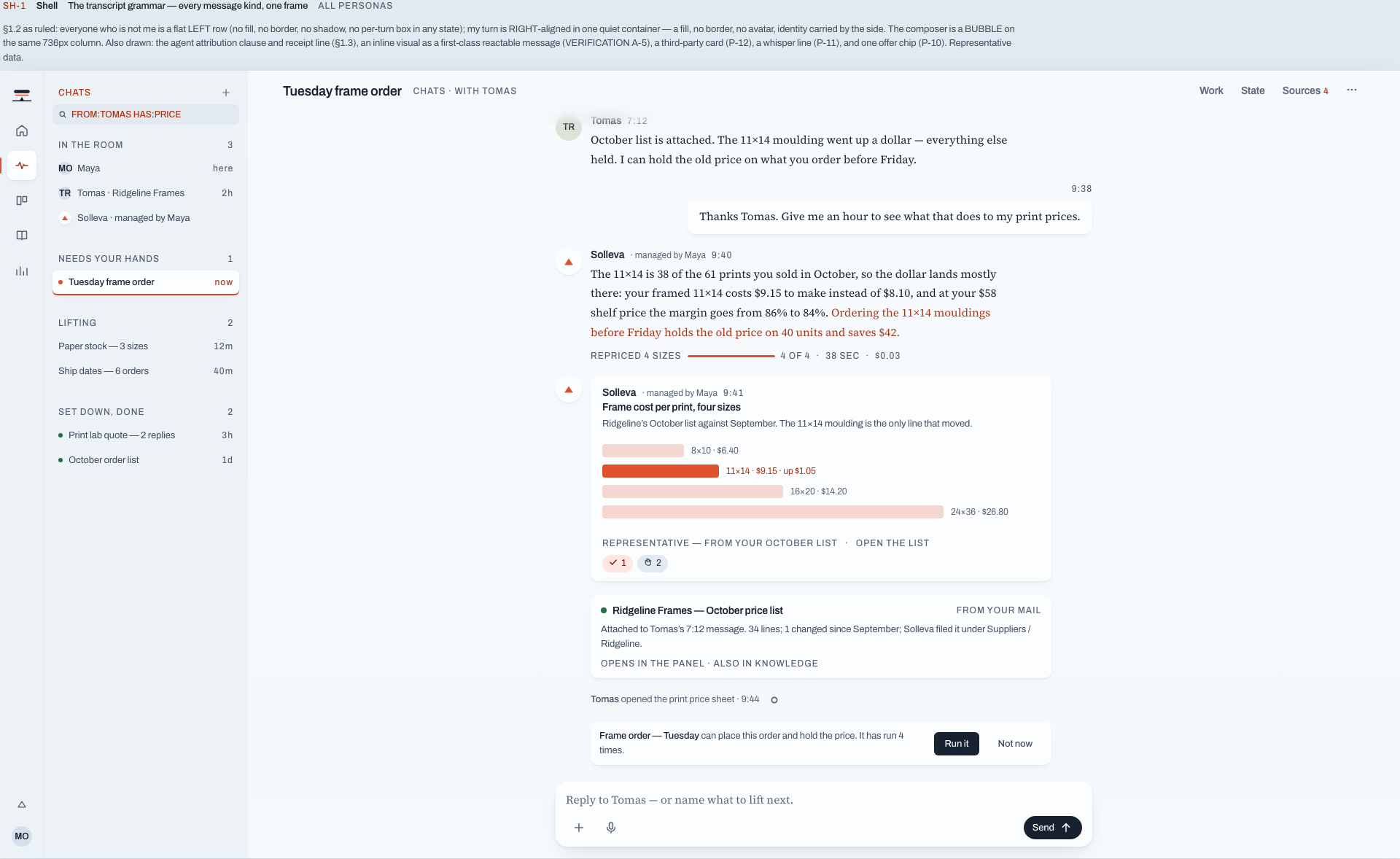
The Solleva desktop, Chats thread 'Tuesday frame order': Tomas's message arrives as a flat row on the left with his name and the time; the reader's own reply sits right-aligned in a quiet bubble; Solleva answers on the left under 'managed by Maya', naming the price move and what ordering before Friday saves; below it an inline chart of frame cost at four sizes, a source card for Ridgeline's October price list, a system line recording that Tomas opened the sheet, and an offer to run the Tuesday frame order playbook.

People talk to each other; the agent is a participant, not the room. Everyone else's messages arrive as flat rows on the left with a name and a time — the agent's too, under the name of the person who manages it. Your own messages are the ones that align right, and the composer at the foot is the one bubble on the screen.

The answer arrives with the thing it stands on. The chart is the four sizes repriced, the card underneath is the supplier list the numbers came from, and the last line offers the playbook that can place the order — all in the thread, nothing in a second tab.

What the reader gets back, in the frame itself: four sizes repriced in 38 seconds for 3 cents, and $42 held on the 40 mouldings by ordering before Friday.

Render from the current desktop journey build — shell frame SH-1, captured 2026-08-04 at 1960×1152. Ridgeline, Maya and every figure in the thread are a worked example, labelled as one, not a customer result.
Playbooks

What you do twice, Solleva runs the third time.

Twice by hand, then offered. The chain runs, runs again with the line tracing one step ahead, then lifts as one form and works above the line — leaving a dotted wake behind it. You stay on the ground holding the string; it brightens each time the run needs your answer.

Learned from your repetition

We see when you are doing the same thing over and over, and we learn how to lift that weight with you.

Solleva watches the work stream for a shape that keeps coming back — the same five moves on the reorder, the same checks on an intake — and offers you a playbook made of your steps. You edit it in plain language. It runs the next time and stops exactly where you told it to stop. The playbook is an asset: readable, correctable, and specific enough to hand to the next person you hire.

Your steps — the order you actually do them in, not a template's
Your checks — the numbers you always look at before you send
Your gates — the moments the run stops and waits for a person
The run log — part of the playbook, not a second thing to keep

How a playbook is made and run →

Knowledge

Ask your own record. Read where the answer came from.

Capture, filed, then cited. What you save, clip, and say falls into one inbox and is sorted into topics. When you ask, the lines trace back up from the exact records the answer stood on.

The record that carries the work

Nothing important lives only in your head, and nothing you keep trains anyone else's model.

Voice memos, web clips, email, messages, documents and typed records land in one place. Solleva does the filing; you keep the thinking. Ask a question and the answer arrives with its sources attached — and a note on what your record is still missing on that topic.

What it captures, and how it answers →

On the go

The same Solleva, in your pocket.

One product, one name, on every device. The phone listens while you work, files what a call decided, sorts your threads by what is waiting on you, and lets your voice write a rule straight onto a running playbook.

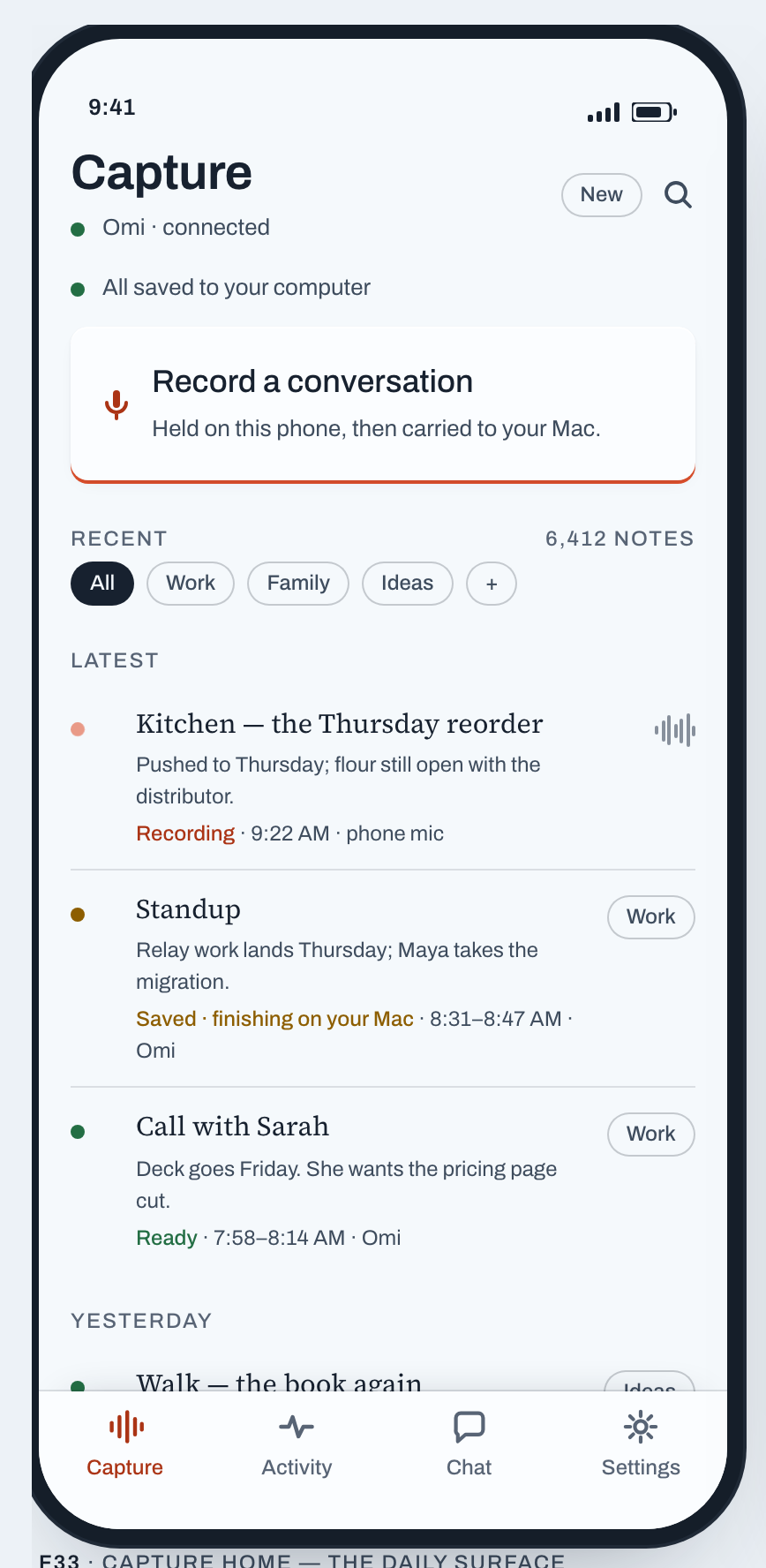
Solleva phone Capture screen: the recorder connected and everything saved to your computer, a Record a conversation card, 6,412 notes in the library, and today's three captures — the Thursday reorder recording, a standup finishing on your Mac, and a call with Sarah marked ready.
Capture. The day lands here: what is recording, what is finishing on your Mac, what is ready to read — each row saying which, in words.
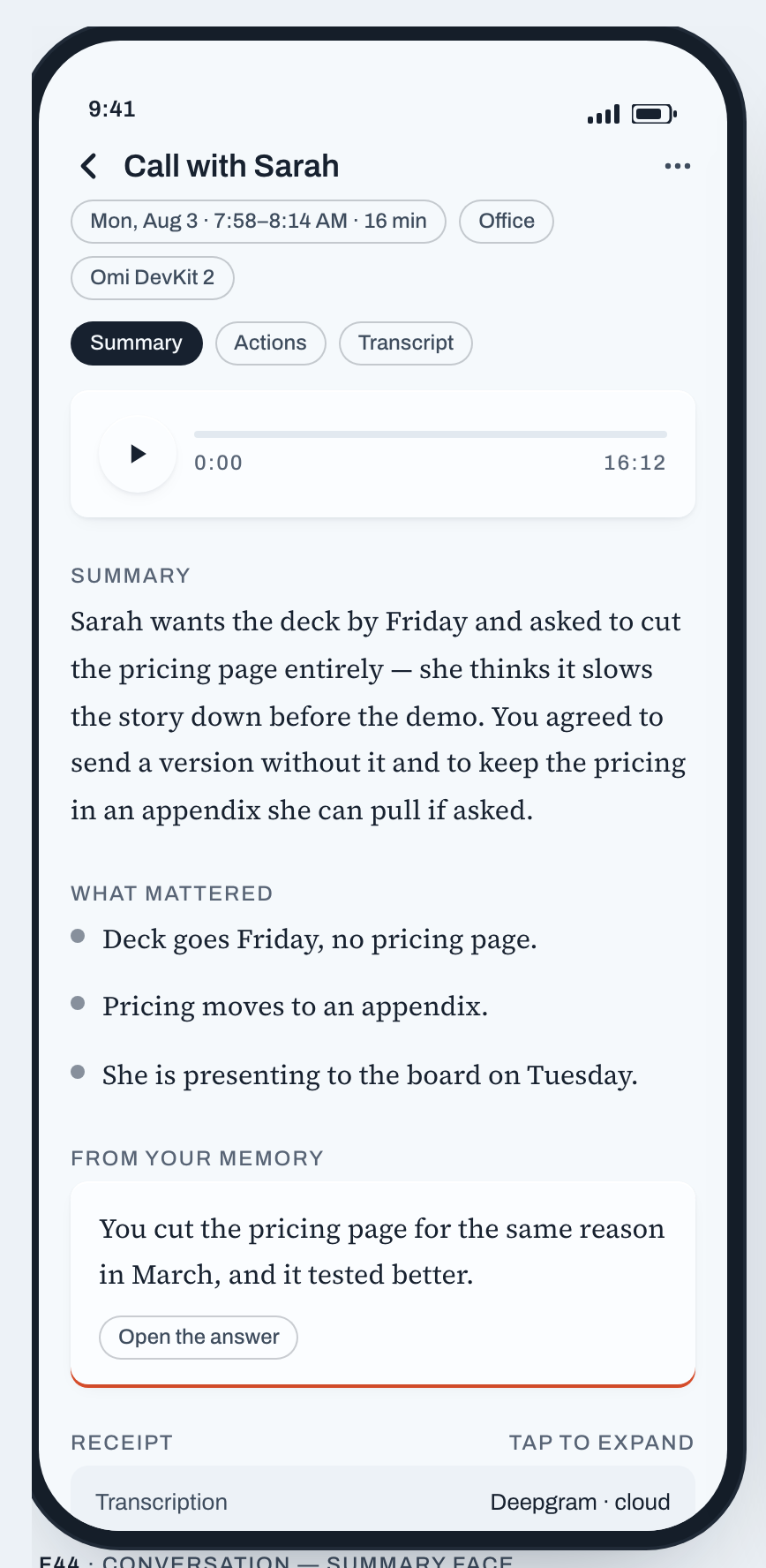
Solleva phone conversation: a sixteen-minute call with Sarah, a summary of what she asked for, three lines under What mattered, a From your memory card recalling the same decision from March, and a receipt naming which service transcribed it.
Review. A sixteen-minute call becomes a summary, three things that mattered, and the note that you decided this once before — with a receipt naming what ran where.
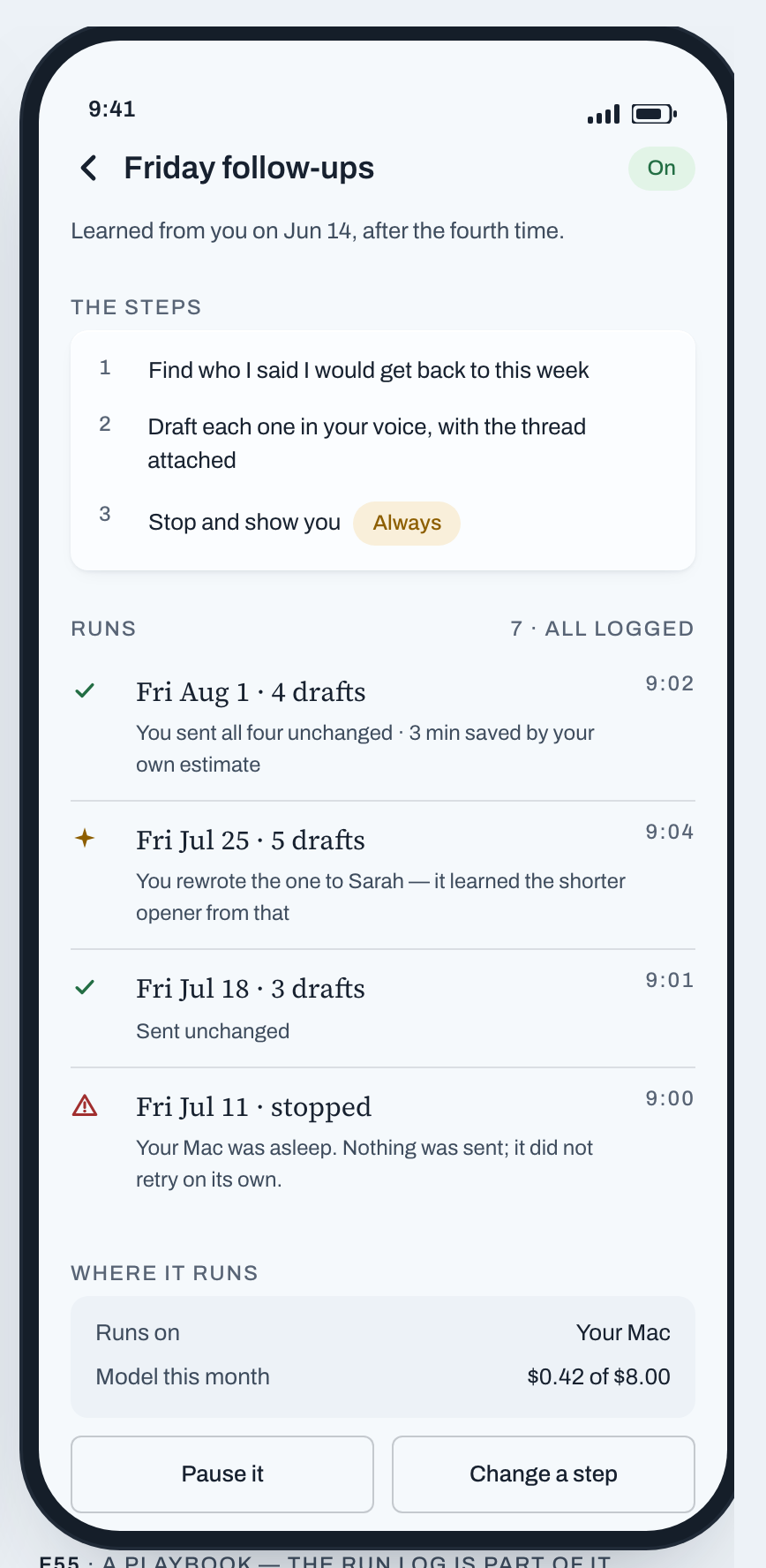
Solleva phone playbook: Friday follow-ups, written from you on Jun 14 after the fourth time, three steps with the third marked Always stop, seven logged runs including one that stopped because the Mac was asleep, and the month's model spend against its ceiling.
The playbook. Your three steps, the one that always stops for you, and every run it has made — including the Friday it stopped and said why.

Renders from the current phone build, phone-v2 frames F33, F44 and F55, captured 2026-08-04 at 868×1776. Names and amounts are a worked example, labelled as one.

Voice notes, the spotter, and agents on the go →

Ambient intelligence

It stands beside the work and stays out of it until it can help.

Nobody is operating this. The day lands and is kept. Then points hours apart begin to glow, a line traces between them, and the small thing they make rises a little and waits. No cursor, no click — and it settles back, still connected.

Off means off

You opt in, the answer at the gate is no by default, and every decision it makes is written down.

Everything up to a candidate happens on your phone. When the feature is off there is no transcript, no gate and no processing at all. When it is on, the gate refuses by default and only a strong enough reason gets through — and the log of what it refused is how you tell an over-eager one from a dead one.

What it listens to, and when →

Cost and custody

The right model for the job, at the cost the job allows.

Cost is distance; capability is glow. A light request leaves and takes the shortest line that satisfies it. A sensitive one is turned inward and never crosses the ring. An unlabeled one darkens as it arrives, the gate closes flat, and it comes back — no outbound line ever starts. Every crossing drops a tick on the log.

One governed door

Which model, at what cost, over which data is a policy you set once — not a decision remade in every feature.

Confidential work defaults to your own machine, and the rule that keeps it there is not something the tuning can touch. Bring your own key and pay us nothing for that inference. Set a ceiling in dollars and the run stops at it, mid-flight, with the log showing where.

The door, the ceiling, and the five kinds of call →

Measurement

Tests check a moment. Measurement tracks a trend.

The bubble moves off centre. A run is held against the standard you approved. The two separate slowly — too slowly to notice by reading — and the watch marks the moment it started, before it compounds.

Evidence, not vibes

Held to the standard you approved, week after week — and it tells you when it stopped holding.

Solleva scores its own work against examples you signed off on, keeps the disagreements instead of averaging them away, and watches for drift continuously rather than in batches. When something is tried, the record says what was tried, what won, and what changed as a result.

What gets measured, and who reads it →

Working together

Several hands on the lift. Each hand keeps its own grip.

Decided direction — in build

Wrapped at the boundary, and a move is a move. Each person's own store stays whole. A thing entering the shared space takes an envelope the moment it leaves home; when access ends the envelopes dim and those pieces go back. A thread that moves goes as one piece and leaves no ghost. The relay carries and never keeps.

Custody is the point

A shared space is a place to work, never a brain that answers for you.

Your answers keep coming from your own agents over your own knowledge. Anything crossing a sharing boundary is wrapped for the person you granted it to; revoking stops the wrapping and rotates forward. Delete means the key is destroyed, and the claim states exactly which copies that covers. Turn your machine off and the shared space loses its access — that is what ownership means here.

Spaces, threads, cells and the relay →

Who it is for

One product. Three ways in.

The promise does not change with the reader: name the work, and Solleva puts the pieces underneath it and lifts. What changes is the delivery.

You start with one real task.

Not a tour — a task. Tell Solleva one thing you want to make, price, or hand off. Twenty minutes from now you have something you can act on and the first step named. If it is wrong, say so: the correction is yours and it is kept.